Restoration Philosophy: What Does It Mean to Preserve a Classic Car?
Every restoration begins with a decision that is larger than paint color, engine parts or upholstery.
What are we trying to preserve?
It sounds like a philosophical question—and it is—but the answer changes every practical decision that follows. It determines whether we clean an old component or replace it, whether we reproduce factory overspray or eliminate it, whether we hide a modern safety improvement or display it proudly, and whether a scar earned over sixty years should be repaired or respected.
The word restoration is used so broadly that it can describe almost anything from a careful mechanical recommissioning to a completely modern automobile wearing an old body. Those projects can all be enjoyable. They are not all trying to accomplish the same thing.
At Fitzgerald Classics, I keep returning to one principle:
Preserving a classic car means understanding what the automobile is, deciding what it should become and making every change intentionally.
That does not demand one rigid standard. It demands honesty.
Preservation, Conservation, Restoration and Modification
These terms overlap in normal conversation, but separating them helps define a project.
Preservation
Preservation protects as much surviving original material as practical. The goal is to stabilize the automobile, maintain it and prevent further deterioration. Wear, patina and evidence of use may remain because they are part of the car’s history.
Conservation
Conservation goes a little further. A component may be cleaned, repaired or carefully stabilized so that it can continue functioning without erasing its age. Museums use this way of thinking, but it also belongs in a home garage.
Restoration
Restoration returns the car toward a selected historical condition—often how it appeared when new or during a documented period of its life. Materials, finishes and assembly details may be renewed or recreated when originals cannot be retained.
Modification
Modification changes the automobile from its historical configuration to improve performance, comfort, safety, appearance or usability. A modification can be subtle and reversible or complete enough to redefine the car.
None of these labels automatically makes a project good or bad. Problems begin when the objective is never defined—or when a modified car is represented as historically original.
Start With the Car You Actually Have
Before deciding what a classic should become, understand what has survived.
A remarkably original automobile deserves a different approach than a basket case missing half its major components. A rare numbers-matching Corvette presents different questions than a common model with a replacement engine and decades of previous repairs. A family heirloom carries a kind of value that no judging manual can measure.
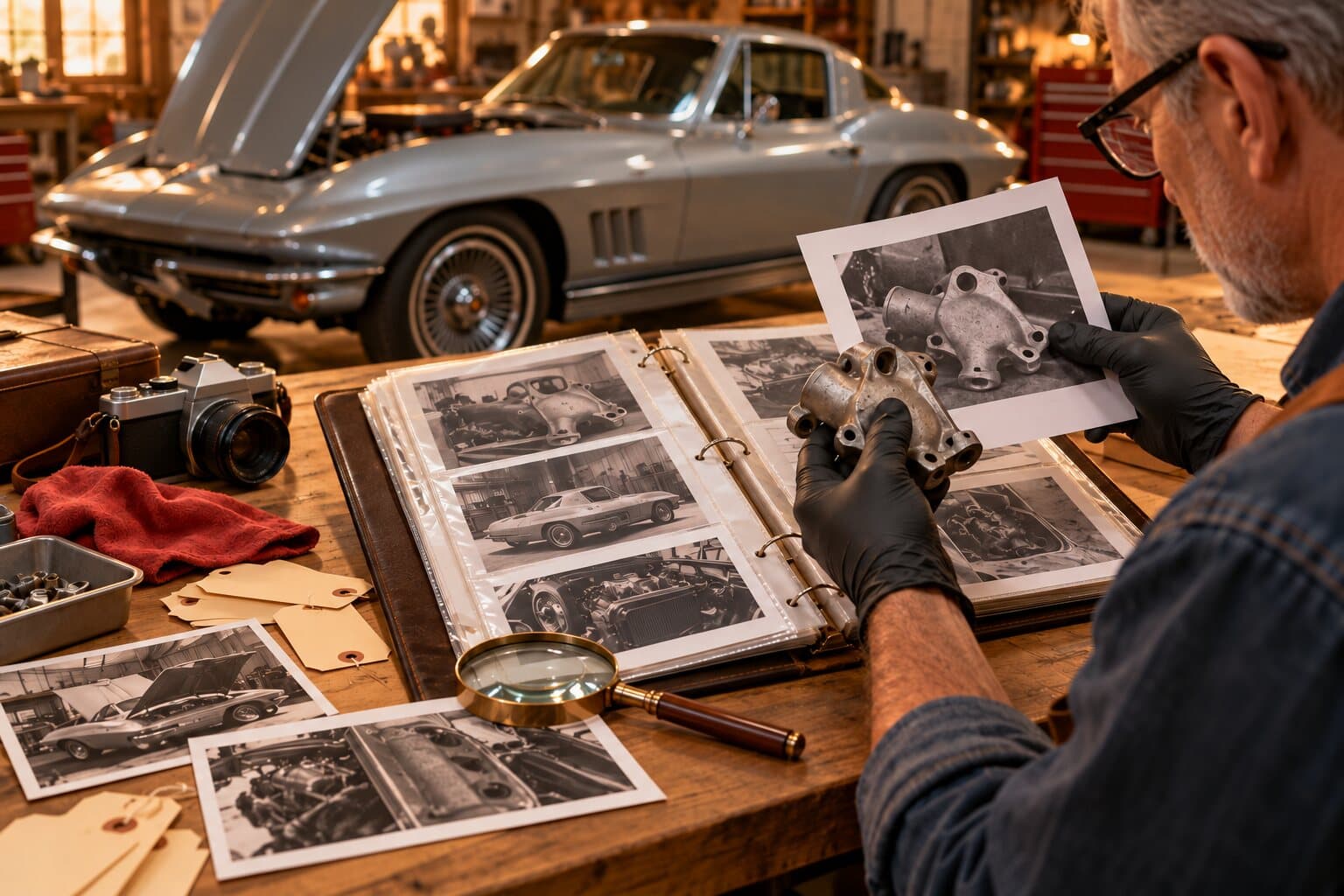
Begin by documenting:
Identification numbers, casting numbers and date codes.
Original finishes in protected areas.
Factory welds, seams, fasteners and markings.
Previous repairs and modifications.
Matching components and significant replacements.
Ownership history, photographs, receipts and correspondence.
Unusual wear that may reveal how the car was used.
Do this before major cleaning or disassembly. Evidence is easiest to destroy when we do not yet recognize it as evidence.
Our article Restore It or Replace It? explores that decision at the component level. Restoration philosophy applies the same discipline to the entire automobile.
Decide How the Car Will Live
A restoration is more successful when the future use is defined at the beginning.
Will the car be:
Preserved as an unusually original example?
Driven regularly on local roads?
Used for long-distance touring?
Judged under marque-specific standards?
Displayed as part of a collection?
Built as a dependable family classic?
Prepared for eventual sale?
Modified for modern traffic and comfort?
The answer affects everything from tires and cooling to paint finish and upholstery.
A concours restoration may justify factory-correct fasteners, date-coded components and carefully reproduced finishes that make little practical difference on a weekend driver. A touring car may benefit from concealed reliability upgrades that would cost points in strict judging. A survivor may lose much of its significance if refinished simply because new paint would be prettier.
There is no universal right answer. There is a right answer for the car, its owner and its intended life—provided those three things have been considered together.
Originality Is Not the Same as Perfection
Originality is often misunderstood as a beauty standard.
An original part may be faded, scratched, oxidized or worn. A reproduction may look cleaner and more precise. If appearance alone decides the question, new parts will usually win.
But originality is about continuity.
The steering wheel worn smooth by decades of hands, the factory-applied seam sealer, the imperfect paint edge behind a bracket and the original fastener with the correct head marking all connect the present automobile to the people who built and used it.
That does not mean every deteriorated piece must remain on the car. Safety, function and preservation sometimes require replacement. The point is to recognize what is being surrendered before making the change.
A discarded original component cannot always be recovered. A reproduction can usually be ordered tomorrow.
Authenticity Is Broader Than Originality
A car can lose original parts and still be restored authentically.
Engines fail. Upholstery wears out. Chrome pits. Wiring becomes unsafe. Tires age regardless of mileage. A responsible restoration replaces materials that can no longer serve while respecting the design, construction and character of the automobile.
Authenticity asks whether the finished result is believable for the car and the period.
Is the finish correct in color, sheen and texture? Does the replacement part fit and function like the original? Does the wiring follow the factory route? Does the interior feel like the automobile’s era? Do improvements disappear into the car, or do they overwhelm it?
The goal is not to pretend that every component survived untouched. The goal is to maintain the truth of the automobile.
Preserve Evidence Before Recreating It
Restoration frequently requires us to remove the very evidence needed to restore accurately.
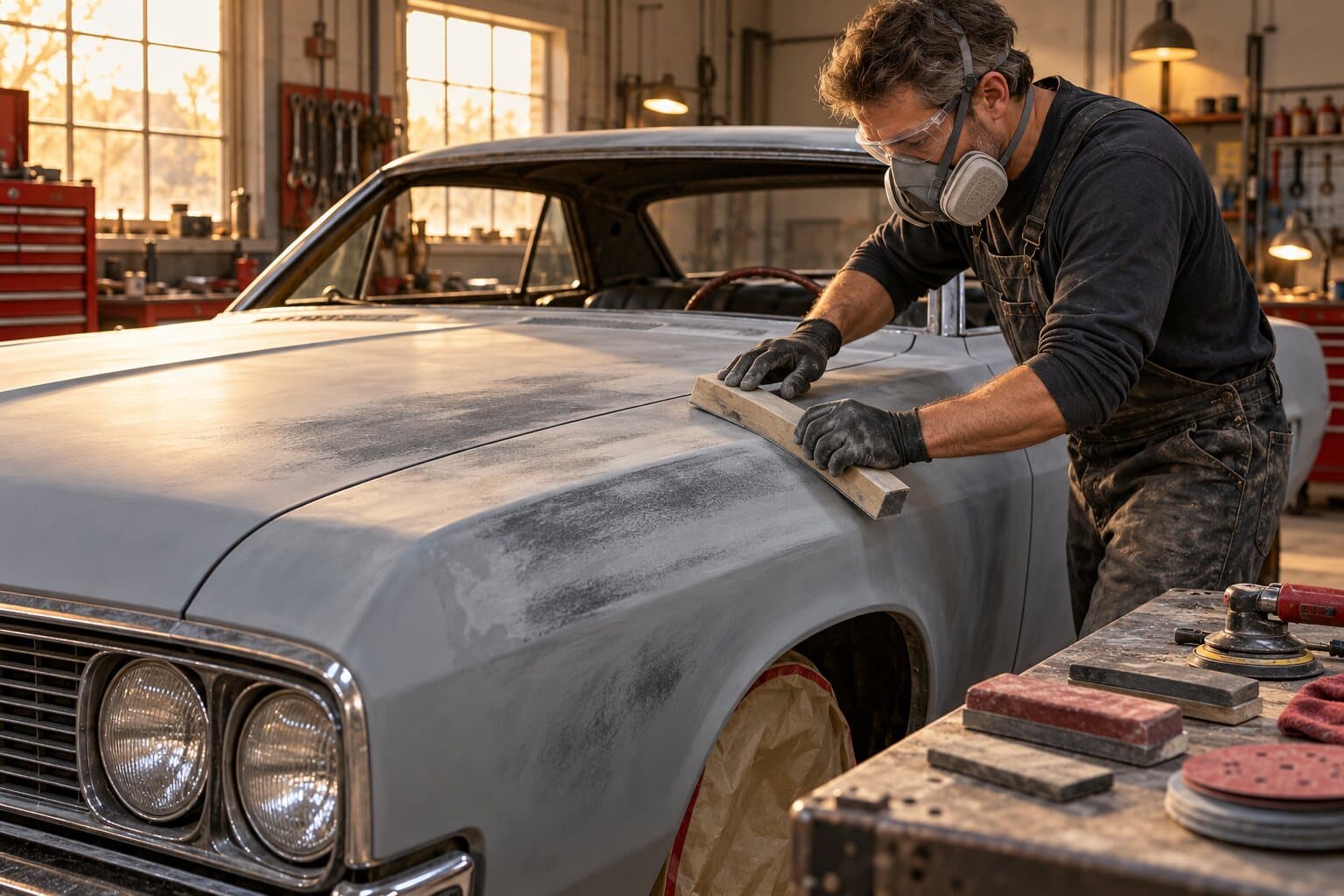
Paint stripping erases overspray and masking lines. Plating removes old finishes. Media blasting can destroy chalk marks and stamps. Replacing a harness eliminates original routing clues. Cleaning hardware can remove markings.
Before changing anything:
Photograph the component in place from wide and close angles.
Record orientation, routing and attachment points.
Note colors, gloss levels and transitions.
Photograph numbers, labels, stamps and hardware heads.
Bag and label removed parts by location.
Save representative samples when material must be replaced.
Compare the evidence with factory documents and unrestored examples.
This work may seem slow, but it protects against confident mistakes later.
The details discussed in Engine Paint Correctness demonstrate why. Factory overspray can reveal assembly sequence. Once stripped away, it becomes research rather than evidence.
Patina or Deterioration?
Patina has become one of the most overused words in the collector-car world.
Authentic patina is the honest surface change created by time, use and care. It can include softened paint, worn upholstery, aged plating and small marks that tell a coherent story.
Deterioration is active damage that threatens the automobile. Rust expanding beneath paint, brittle fuel hose, failing brake lines, rotted structural material and crumbling insulation are not romantic. They are problems.
The difference is not always visual. A faded finish may remain stable for years. A glossy panel can conceal corrosion. A cracked seat may be historically beautiful but continue tearing every time someone drives the car.
Ask three questions:
Is the condition stable?
Does it affect safety or function?
Will leaving it alone destroy more original material?
Preservation does not mean watching an automobile decay. Sometimes intervention is the most preservation-minded choice.
Safety Is Part of Preservation
A car that cannot be operated safely may survive as an artifact, but it cannot fulfill the purpose for which it was built.
Brakes, steering, tires, fuel systems and electrical protection deserve priority. Original appearance should never be used to justify a known hazard.
The best safety improvement is often one that respects the car and can be reversed:
Modern tires in a period-appropriate size and appearance.
A dual-circuit master cylinder when appropriate to the project’s purpose.
Concealed relays that reduce current through an original switch.
Fused accessory circuits.
Improved internal materials inside an original-looking component.
Seat belts installed without unnecessary destruction.
A fire extinguisher mounted accessibly but discreetly.
Not every car requires every upgrade. Research compatibility, understand judging consequences and document what changed.
Safety decisions should be deliberate—not hidden from a future owner and not dismissed simply because the factory built the car differently sixty years ago.
Reversibility Is a Powerful Standard
When uncertain about a modification, ask whether the car can be returned to its prior configuration without major damage.
A hidden electronic ignition module inside an original distributor is more reversible than cutting the firewall for a modern system. A radio that fits the factory opening is more reversible than enlarging the dash. A bolt-on suspension improvement is more reversible than welding new structure into an intact frame.
Reversibility does not make every modification appropriate, but it preserves future choices.
When original components are removed, label and store them with the car. Include instructions, photographs and hardware. A modification becomes less destructive when the next owner can understand and undo it.
The Danger of Over-Restoration
A restored automobile can become more perfect than the factory ever built it.
Panel gaps can be made unnaturally uniform. Castings can be polished until texture disappears. Hardware can be plated more brightly than original. Paint can become deeper and glossier than period production methods produced. Undercarriages can be finished like jewelry.
That workmanship may be exceptional. It may also move the car away from historical accuracy.
Our article on classic-car body panel alignment explains that factory character and poor workmanship are not the same thing. The objective is not to reproduce defects blindly. It is to understand the standard the factory was capable of and the evidence the specific automobile provides.
An authentically restored car should look carefully renewed, not as though every manufacturing trace was redesigned by a modern show-car shop.
Reproduction Parts Require Judgment
Reproduction parts make many restorations possible. Without them, countless automobiles would remain incomplete.
Quality varies. A reproduction may differ in material, contour, finish, markings, fit or durability. Sometimes it is better than a worn original. Sometimes the original can be rebuilt. Sometimes neither option is perfect.
Before replacing an original component:
Identify exactly what it is.
Determine whether it can be repaired.
Compare reproduction details and reviews.
Consider fit before refinishing surrounding parts.
Preserve the original even if the reproduction is installed.
Document why the decision was made.
A restored car is not diminished simply because it contains reproduction components. It is diminished when poor replacements erase correct, recoverable originals without thought.
Three Cars, Three Different Answers
My own projects illustrate why one philosophy cannot fit every automobile.
The 1966 Corvette
A numbers-matching Corvette with documented history and significant original components rewards careful research. Casting dates, factory finishes, fasteners and configuration matter because the car still possesses continuity worth protecting.
The temptation is to make every surface flawless. The responsibility is to distinguish factory-correct detail from modern perfection.
The 1957 Nash Metropolitan
The Metropolitan began from a different place. It was acquired as an affordable project intended to become a high-quality driver. Reliability, safety, charm and honest presentation matter enormously. A sensible modern improvement can be appropriate when it allows the car to be used without destroying its character.
Its positive-ground history and modern negative-ground radio taught us that appearance and function do not always tell the same story. The correct solution required understanding both the original design and the rebuilt component.
The 1963 Ford Galaxie 500 Convertible
A largely complete, usable classic can benefit from restraint. Not every car needs to be disassembled to the last fastener. Maintenance, selective restoration and careful documentation may preserve more character than a complete rebuild.
The condition, rarity, originality and intended use of each car determine the philosophy. The owner’s preferences matter—but the automobile deserves a voice in the decision.
Judging Standards Are Tools, Not Commandments
Marque clubs and judging organizations preserve enormous amounts of knowledge. Their manuals can identify finishes, hardware, routing and configurations that would otherwise be lost.
Use that information even if the car will never be judged.
But a judging standard is designed for a particular class and purpose. It should inform the restoration rather than replace the owner’s objective. A driver built for summer tours may make different choices from a national-level judged car.
Be honest about those choices. “Correct for judging” and “best for my use” can both be valid answers. They are not always the same answer.
Value Follows Coherence and Honesty
Owners naturally wonder which approach creates the greatest financial value.
Originality, rarity, documentation and workmanship all matter, but markets are not perfectly predictable. A sympathetic restoration can be valuable. An exceptional survivor can be more valuable. A tasteful restomod may appeal to a different buyer. A poorly executed project can lose money regardless of category.
The strongest cars usually make sense.
The condition supports the story. The modifications support the intended use. The documentation supports the claims. The workmanship is consistent. Nothing important is disguised.
When buying your first Corvette, the same principle applies: buy the story you can prove and the car you will actually use.
Build a Written Restoration Charter
Before major work begins, write a one-page restoration charter.
Include:
What the car is today.
What makes it historically or personally significant.
Intended use after completion.
Target standard: preservation, restoration, modification or a blend.
Original components that must be retained.
Safety and reliability priorities.
Modifications considered acceptable.
Areas where reversibility is required.
Documentation and photography standards.
Budget boundaries and stopping points.
This document prevents decisions made in frustration from quietly changing the entire project.
If a new idea appears halfway through, compare it with the charter. The idea may be excellent. It may belong on another car.
A Decision Test for Every Change
Before changing a component, ask:
What evidence do I have?
Is the original component safe and functional?
Can it be conserved or rebuilt?
What historical information will be lost?
Does the replacement fit the project’s purpose?
Is the change reversible?
Will it create problems elsewhere?
Have I documented the original condition?
Am I making the change for the car—or because new parts are easier?
Will I be comfortable explaining the decision to the next owner?
If the answers are clear, proceed confidently. If they are not, pause. Most restoration decisions improve with an extra day of research.
Common Restoration-Philosophy Mistakes
Beginning disassembly before documenting the car.
Assuming newer automatically means safer or better.
Treating every aged surface as damage.
Calling active deterioration “patina.”
Chasing judging correctness on a car intended for frequent touring without acknowledging the tradeoffs.
Modifying rare original structure for convenience.
Throwing away replaced parts.
Making irreversible changes before driving the car.
Over-restoring finishes beyond believable factory quality.
Allowing resale value to become the only definition of success.
Describing modifications as original.
Changing the project standard halfway through without revisiting budget and purpose.
Fitzgerald Insight
The longer I work on old cars, the less I believe restoration is about returning time to zero.
We cannot make the automobile new again in the truest sense. The people who built it have moved on. The roads, dealerships and owners that shaped its life belong to another time. Even a flawless restoration carries the knowledge that decades have passed.
What we can do is decide which parts of that history deserve to travel forward.
Sometimes that means preserving worn paint. Sometimes it means rebuilding an original gauge. Sometimes it means replacing a dangerous brake hose. Sometimes it means accepting that a reproduction part is the only practical way to return the car to the road.
The quality of the restoration is not measured only by how much changed.
It is measured by how well we understood the car before we changed it.
That understanding is what transforms repair into stewardship.
Frequently Asked Questions
Is a restored car less valuable than an original survivor?
Not necessarily. Rarity, condition, documentation, workmanship and market demand all influence value. Exceptional survivors are prized because original material cannot be recreated, while correctly restored cars can also be highly valuable. Honest representation matters in either case.
Should every classic car remain factory original?
No. Intended use, condition and personal goals matter. Modifications should be safe, coherent and honestly documented. Rare, highly original cars generally deserve greater restraint than incomplete or heavily altered examples.
When should patina be preserved?
Preserve patina when it is stable, historically meaningful and compatible with safe use. Intervene when deterioration threatens structure, function or additional original material.
Are hidden modern upgrades acceptable?
They can be, especially on drivers, when they improve safety or reliability without damaging original structure. Research compatibility, preserve removed parts and document the change.
Is it wrong to build a restomod?
No. A well-engineered restomod can be an outstanding automobile. The key is to begin with an appropriate candidate, execute the work safely and avoid misrepresenting it as an original restoration.
What should I do with original parts I replace?
Label, photograph and store them with the car whenever practical. Include related hardware and a note explaining why they were removed. They may matter to a future restoration or owner.
Preserve the Car—and the Truth
A classic automobile is both a machine and a historical object.
It should stop safely. It should operate reliably enough for its intended use. It should also retain the details, evidence and character that make it more than an old shape containing new parts.
Choose a philosophy before choosing the finish. Document before disassembling. Repair before replacing when it makes sense. Modify with restraint. Preserve future choices. Be honest about the result.
If the finished car looks right, drives as intended and tells a true story, the restoration has accomplished something more important than perfection.
It has preserved meaning.
Continue the Fitzgerald Classics Journey
Explore Fitzgerald Classics for practical restoration guidance, real-garage lessons and documented project stories from the 1966 Corvette, 1963 Ford Galaxie 500 convertible and 1957 Nash Metropolitan.
Coming Next
Next Friday, the original Fitzgerald Classics 52-week editorial roadmap continues with:
Classic Car Paint Preparation: The Finish Is Only as Good as What Lies Beneath
We’ll cover stripping and assessing old finishes, metal and fiberglass repair, cleaning, sanding, blocking, guide coats, primer selection, panel-edge protection and why preparation determines whether beautiful paint lasts.
About the Author
Dan Fitzgerald is the founder of Fitzgerald Classics, a Veteran-Owned automotive publication dedicated to preserving America’s automotive heritage through authentic restoration stories, practical technical guidance and hands-on experience. From documenting a numbers-matching 1966 Corvette to bringing a 1957 Nash Metropolitan back to life, Dan shares the discoveries, mistakes and lessons that happen in a real garage so other enthusiasts can approach their own projects with greater knowledge and confidence.