Should You Put a Car Lift in Your Home Garage? Two-Post vs. Four-Post vs. Portable Lifts
If you spend enough time restoring old cars, there comes a point when working on your back starts to feel less like a badge of honor and more like a bad decision.
I am getting close to that point myself.
A lift is one of those tools I have thought about for a long time, but recently I have started looking at it more seriously. Between restoration work, maintenance, under-car inspections and simply trying to make the garage more useful, the idea starts to make a lot of sense.
What surprised me is how many choices there are now for a home garage. You no longer have to think only in terms of a full commercial shop lift. There are portable systems, conventional two-post lifts and four-post lifts designed for both service and storage.
The right answer depends on what you actually want the lift to do.
The Three Lift Styles Most Home Restorers Should Consider
For most classic-car owners, the decision comes down to three basic types:
- Portable frame lifts
- Two-post lifts
- Four-post lifts
Each has a legitimate place in a home garage.
1. Portable Lift Systems
Portable systems such as QuickJack are the easiest way to gain useful working height without permanently dedicating a bay to a full-size lift.
Instead of lifting the car several feet into the air, the frames sit alongside the vehicle and raise it from appropriate lifting points. You still work closer to the floor than you would with a full two-post lift, but the improvement over jack stands is substantial.
Why they make sense
- They work in garages with lower ceilings.
- They do not require full-height columns.
- They can usually be stored when not in use.
- They are useful for brakes, suspension, exhaust, detailing and under-car inspection.
- They avoid permanently giving up a garage bay.
What you give up
The biggest compromise is working height. You are not standing under the vehicle.
That matters if you plan to do transmission work, extensive exhaust fabrication, floor-pan work or long sessions beneath the car.
A good current example is the QuickJack 6000TL, rated for 6,000 pounds. Its current manufacturer price is about $1,925, although retail pricing can vary.
Check QuickJack 6000TL options on Amazon
For someone who wants a major improvement over floor jacks without committing to a permanent installation, this is probably the easiest entry point.
2. Two-Post Lifts
If my decision were based strictly on restoration work, a two-post lift would probably be my first choice.
A two-post lift supports the vehicle at designated frame or body lifting points. That leaves the wheels, brakes, suspension, exhaust, transmission and much of the underbody completely open.
That access is the biggest reason professional repair shops use them so heavily.
Why they are so useful
- Excellent access to brakes and suspension.
- Wheels hang free.
- Exhaust and drivetrain work are much easier.
- The center of the garage floor remains relatively open on a clear-floor design.
- They are ideal for serious mechanical restoration.
What you need to think about
A two-post lift is much more dependent on correct installation.
You need adequate concrete, correct anchor installation, enough ceiling height and enough room around the columns to open the doors of the car.
You also need to be comfortable identifying the correct lifting points for every vehicle.
A strong premium example is the APEX AL10C, a 10,000-pound clear-floor two-post lift. The current manufacturer price is about $4,195.
Shop 10,000-lb two-post lift options on Amazon
There are cheaper two-post lifts on the market, but this is one area where I would be much more interested in engineering, parts support and installation quality than simply buying the least expensive unit.
3. Four-Post Lifts
A four-post lift solves a different problem.
The car drives onto runways and stays supported by its tires. That makes loading the vehicle easy and makes a four-post lift particularly attractive for storage.
If you have the ceiling height, one garage bay can effectively become two parking spaces.
For a classic-car owner with limited garage space, that is a real advantage.
Why they are attractive
- Very easy to drive on and off.
- Excellent for storing one car above another.
- Good for fluid changes, inspections and under-car access.
- Often feel more natural to people who are uncomfortable positioning lift arms.
- They can be ideal for collector-car storage.
The tradeoff
The wheels remain loaded on the runways.
If you want to do brake, suspension or wheel work, you generally need a bridge jack or another method of lifting the car off the runways.
That adds cost.
A good current example is the BendPak HD-9, a 9,000-pound four-post lift. Its current manufacturer price is about $6,095.
Shop 9,000-lb four-post lift options on Amazon
If storage is nearly as important as restoration work, this style becomes very compelling.
Which One Would I Choose?
For a restoration-focused home garage, I would rank them this way:
- Two-post lift — best overall if the priority is mechanical work and restoration access.
- Four-post lift — best if storage is equally important.
- Portable lift — best if ceiling height, floor space or permanent installation is the limiting factor.
That does not mean the most expensive option is automatically the best choice.
The best lift is the one that fits the actual garage and the work you really do.
Ceiling Height Matters More Than You Think
Before getting excited about a particular model, measure the garage carefully.
You need to know:
- Floor-to-ceiling height
- Garage-door track height
- Garage-door opener position
- Vehicle height
- Lift height
- Whether the hood, roof or windshield frame could contact anything overhead
The garage door itself is often the hidden problem.
A standard door and opener can take up valuable overhead space even when the ceiling is high enough. Some owners convert to high-lift door tracks or side-mounted openers to gain clearance.
That can be worthwhile, but it belongs in the budget from the beginning.
The Concrete Is Part of the Lift
This is especially important with two-post lifts.
The lift does not simply sit on the floor. The slab becomes part of the installation.
The manufacturer will specify minimum concrete thickness and strength. That specification should be treated as a requirement, not a suggestion.
If you do not know what is beneath the garage floor, verify it before installation.
A lift is not a place to guess.
Think About the Cars You Actually Own
Lift capacity is only one number.
You also need to think about:
- Wheelbase
- Track width
- Ground clearance
- Frame design
- Body construction
- Side-pipe clearance
- Jacking points
- Door-opening space
That matters with classic cars because they were not all designed around the same lifting geometry.
A low Corvette with side pipes presents a different challenge than a body-on-frame full-size convertible.
The lift has to work with the vehicles you actually intend to put on it.
Do Not Ignore Parts and Service Support
A car lift is a long-term tool.
Cables, seals, cylinders, locks, switches and wear items eventually matter.
Before buying, I would want to know:
- Can replacement parts be ordered easily?
- Is technical support available?
- Are installation instructions clear?
- Are service parts still likely to exist years from now?
- Does the company have an established dealer or support network?
That is one reason I tend to favor established lift manufacturers over an unknown bargain brand.
Saving money at purchase can become expensive if a small unavailable part leaves the lift unusable later.
The Real Cost Is More Than the Lift
The advertised price may only be the beginning.
Depending on the type of lift, the full project can also include:
- Freight or delivery
- Installation
- Electrical work
- Concrete work
- Garage-door changes
- Rolling bridge jacks
- Drip trays
- Casters
- Wheel stops
- Vehicle-specific adapters
A $4,000 lift can easily become a larger project once the garage itself is ready for it.
That does not make it a bad investment. It just means the decision should be made using the installed cost rather than the catalog price.
From the Fitzgerald Classics Garage
A lift is a major piece of equipment, but it works best as part of a garage that is organized around safe, repeatable work.
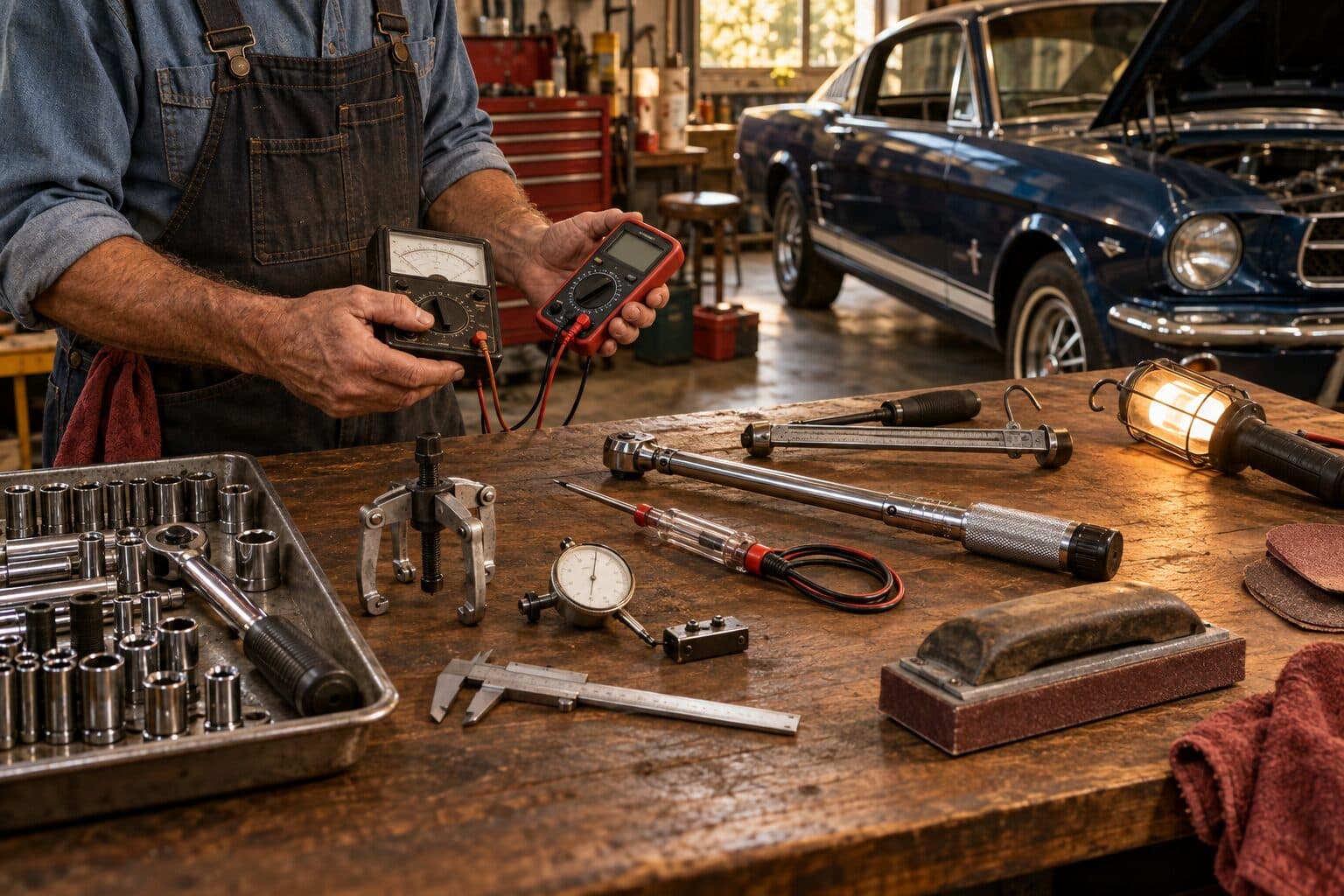
The Fitzgerald Classics Garage includes tools and products we use or recommend for restoration work, including work lights, magnetic parts trays, diagnostic equipment, mechanical tools and detailing supplies.
Explore the Fitzgerald Classics Garage
For under-car work in particular, a good rechargeable work light and a magnetic parts tray are two inexpensive tools that suddenly become much more useful once you are spending more time beneath the car.
Vintage Parts Still Matter Once the Car Is in the Air
One of the realities of restoration is that the job often stops because of a missing part, not because of a missing tool.
That is why we also maintain our Vintage & Hard-to-Find Parts page.
It is where we track original, NOS, discontinued and difficult-to-source parts that can be useful when a restoration needs something that simply is not available new.
Browse Vintage & Hard-to-Find Parts
Some of those listings use our eBay affiliate tracking. As with our Amazon Associate links, those links help support Fitzgerald Classics without increasing your purchase price.
My Decision
I have not made the final choice yet.
At the moment, the two-post lift is probably the most attractive to me because I am thinking primarily about restoration work.
But the four-post option is difficult to ignore because of the storage advantage.
And a portable system still has a very strong argument if I decide I do not want to permanently dedicate the garage space.
That is exactly why this subject is worth thinking through before buying anything.
A lift is not simply a bigger jack.
It changes how the garage works.
For the right owner, it can make restoration work safer, more comfortable and much more practical.
If you already have a lift in your garage, I would be interested to know which style you chose and whether you would buy the same one again.
Manufacturer prices referenced above were current when this article was prepared on October 30, 2026 and can change. Always verify vehicle weight, approved lifting points, concrete requirements, installation specifications and local requirements before purchasing or installing a lift.
Coming Next
Next Friday, the original Fitzgerald Classics editorial roadmap continues with:
Classic Car Documentation and NCRS: Proving the Story Behind the Restoration
We will look at photo logs, casting and date codes, receipts, judging references, parts records, restoration binders and digital archives—and how careful documentation protects a classic car's authenticity, history and value.
About the Author
Dan Fitzgerald is the founder of Fitzgerald Classics, a Veteran-Owned automotive publication dedicated to preserving America's automotive heritage through authentic restoration stories, practical technical guidance and hands-on experience.